


A fire tore through a bus carrying an airport-bound Chinese tour group on National Freeway No. 2 yesterday afternoon, killing all 26 people onboard. The cause of the fire is under investigation.
The 24-member tour group from Dalian in Liaoning Province included 15 women, six men and three youngsters, the youngest of whom was 11, the Tourism Bureau said, while the other two fatalities were the bus driver, Su Wen-cheng (蘇文成), and a guide surnamed Cheng (鄭).
The group had arrived in Taiwan on Tuesday last week and were scheduled to return home yesterday afternoon on a flight from Taiwan Taoyuan International Airport, the bureau said.
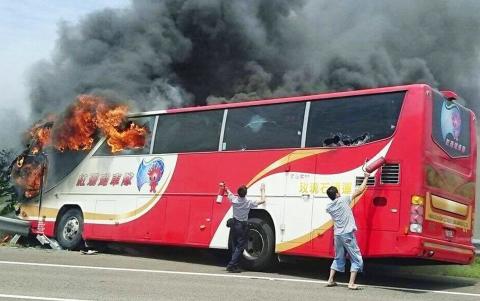
Photo: AP / Yan Cheng / Scoop Commune
The National Highway Police Bureau said the bus appeared to have veered out of control after catching fire and then hit the guard rails on the outer lane of the freeway’s westbound lanes.
Police bureau footage shows smoke emerging from the roof of the bus as the driver drove along the inner lane of the freeway.
The bus then hit a traffic island separating the freeway’s westbound lane and eastbound lanes before running into the guard rail along the outer lane.
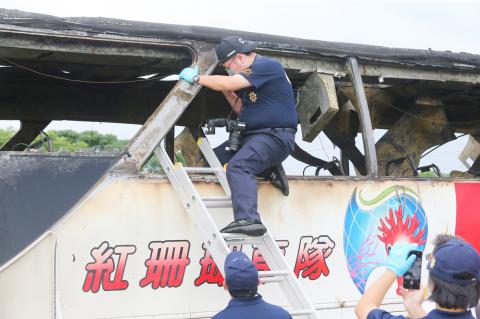
Photo: CNA
The drivers of other vehicles pulled over and attempted to put out the flames with fire extinguishers, but the fire had grown too large for them to put out, the Central News Agency reported.
Thirteen firefighting vehicles and 30 firefighters were sent to the scene, but the bus was an inferno by the time they arrived.
“There was not enough time for them to escape,” Taoyuan Fire Department chief Lai Chi-chong (賴志忠) told reporters.
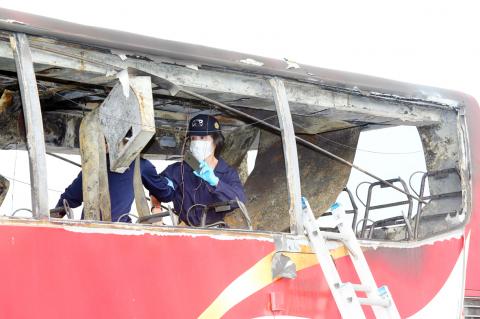
Photo: CNA
Firefighters and accident investigators who examined the charred remains of the bus said the passengers appeared to have tried to move to the back of the bus so they could leave through the emergency exit on the right side of the vehicle.
The Directorate-General of Highways (DGH) said that the bus’ main door and its emergency exit appeared to have been blocked by the guard rail, which probably explained why the doors were not opened.
The Chinese-language Liberty Times (the sister newspaper of the Taipei Times) quoted an unnamed eyewitness as saying passengers were pounding on the bus windows for help as the driver swerved sharply before the crash.
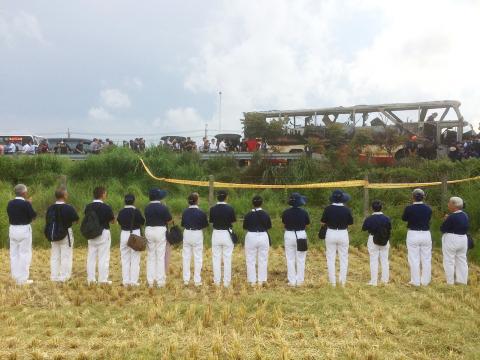
Photo courtesy of the Buddhist Compassion Relief Tzu Chi Foundation
DGH records show that the bus left its manufacturer in May 2010 and passed every required inspection at the vehicle supervision office.
The records also show that Su obtained his license to drive large passenger vehicles in 1996 and had no record of driving while intoxicated.
The tour bus company that owned the bus has four others of the same model and the DGH said it has asked the firm to suspend use of the four immediately.
The agency said those four buses, along with similar models owned by other tour bus firms, would be recalled and be inspected by technical specialists from the manufacturer.
Passenger buses must be equipped with at least three emergency hammers to break the windows and have two fire extinguishers, the DGH said, and buses with a capacity for 32 to 47 passengers must also have five emergency exits.
DGH records show that there have been 37 bus fires since 2006, but yesterday’s was the first one in which the vehicle was completely destroyed and where there were so many casualties.
The Tourism Bureau said the Chinese travel agency that put together the tour group and the Taiwanese travel agency that arranged the tour had bought insurance policies for each member of the group, while the bus company also has insurance covering its passengers.
There have been a total of 98 accidents involving Chinese tourists since 2008, in which 90 people were killed and 390 injured.
Of those accidents, 38 involved tour buses, accounting for 25 deaths and 273 injuries.
Yesterday’s fire was the deadliest incident involving Chinese tourists since a tour bus crash in 2010 killed 19.
Additional reporting by CNA and AP

‘NO SECURITY RISK’: The Railway Bureau reassured the public that the technicians’ activities were limited to technical guidance and did not involve sensitive systems The Railway Bureau yesterday said it had invited eight Chinese technicians to assist with an airport MRT construction project. The bureau issued the confirmation after an Internet user said Chinese nationals had entered the construction zone of Taiwan Taoyuan International Airport’s Terminal 3 project. They asked why “individuals from an enemy state” were allowed access to such a major national infrastructure project, which raised serious concerns over Taiwan’s industrial safety, sensitive systems and information security. The bureau’s Northern Region Engineering Branch Office said subcontractor Taiwan Handle Industrial Co (台灣手把工業) of the Taoyuan airport MRT’s “Contract No. CU05 Project A14 Station Civil, MEP &

A US uncrewed surface vessel (USV) encountered multiple Chinese warships during an autonomous transit of the Taiwan Strait, US defense company Seasats said in a statement on Wednesday. Seasats announced that a Lightfish USV had completed the first autonomous transit of the Taiwan Strait. Over five days, the USV traversed the entire length of the Strait while constantly monitoring surface vessel traffic, the company said. The Lightfish encountered multiple Chinese warships, one of which was a Chinese People’s Liberation Army Navy (PLAN) Type 056 corvette, it said. The Chinese vessels were operating “well within Taiwan’s exclusive economic zone without transmitting their identity via the

‘BOOMING’: ’ The number of partners we have here is incredible. You can see from their stock prices. They’re doing so well, they’re so happy,’ Jensen Huang said Nvidia Corp’s spending in Taiwan has ballooned to about US$150 billion a year, 10 times the US$10 billion to US$15 billion the company spent five years ago, Nvidia chief executive officer Jensen Huang (黃仁勳) said yesterday, suggesting Taiwan’s strategic importance in the global artificial intelligence (AI) supply chain. “Taiwan is the epicenter of the AI revolution. This is where the chips come, packaging comes. This is where the systems are made. This is where AI supercomputers were created,” Huang said at a meeting for the company’s employees in Beitou-Shilin Technology Park (北投士林科技園區) in Taipei, the planned site of Nvidia’s Taipei headquarters. “Taiwan
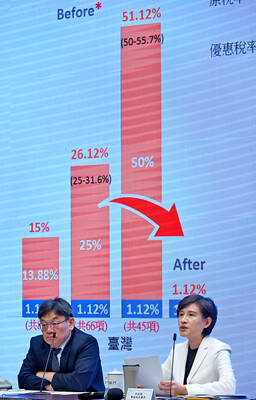
GREATER REACH? Auto parts and wood products would face tariffs of up to 15%, matching those targeting the EU, Japan and South Korea, Vice Premier said The US has announced that preferential tariff treatment for Taiwan’s non-semiconductor Section 232 goods would take effect retroactively from May 1, the Executive Yuan said yesterday. The US government yesterday posted a notice on the Federal Register’s public inspection Web site previewing tariff concessions for Taiwan under a memorandum of understanding (MOU) on Taiwan-US investment after two months of negotiations. The MOU signed on Jan. 15 stipulated three major preferential tariff arrangements: a 15 percent “reciprocal” tariff rate for Taiwan without stacking most-favored nation (MFN) rates; preferential Section 232 treatment for semiconductors and related products; and preferential Section 232 treatment for non-semiconductor


 RSS
RSS